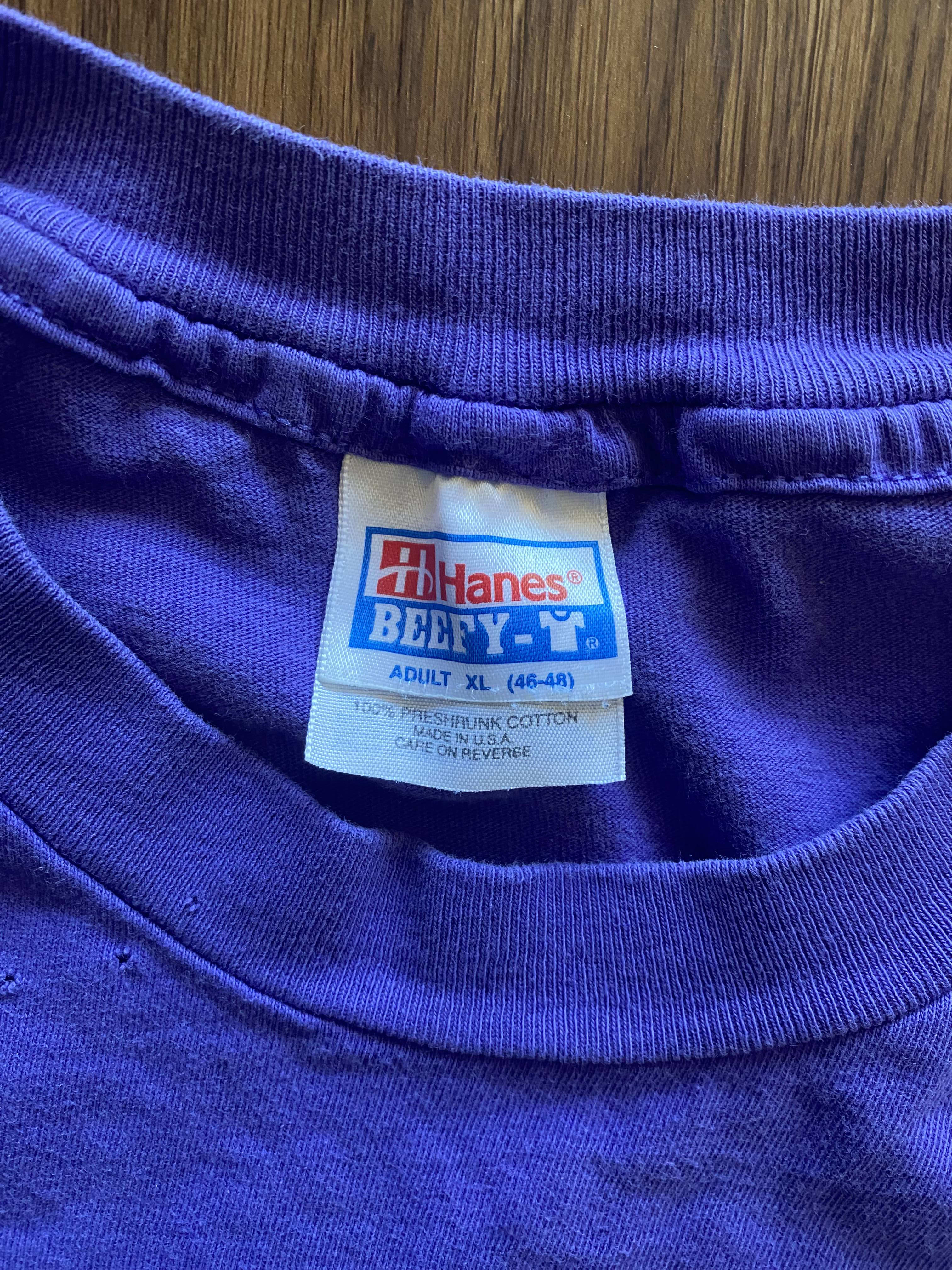
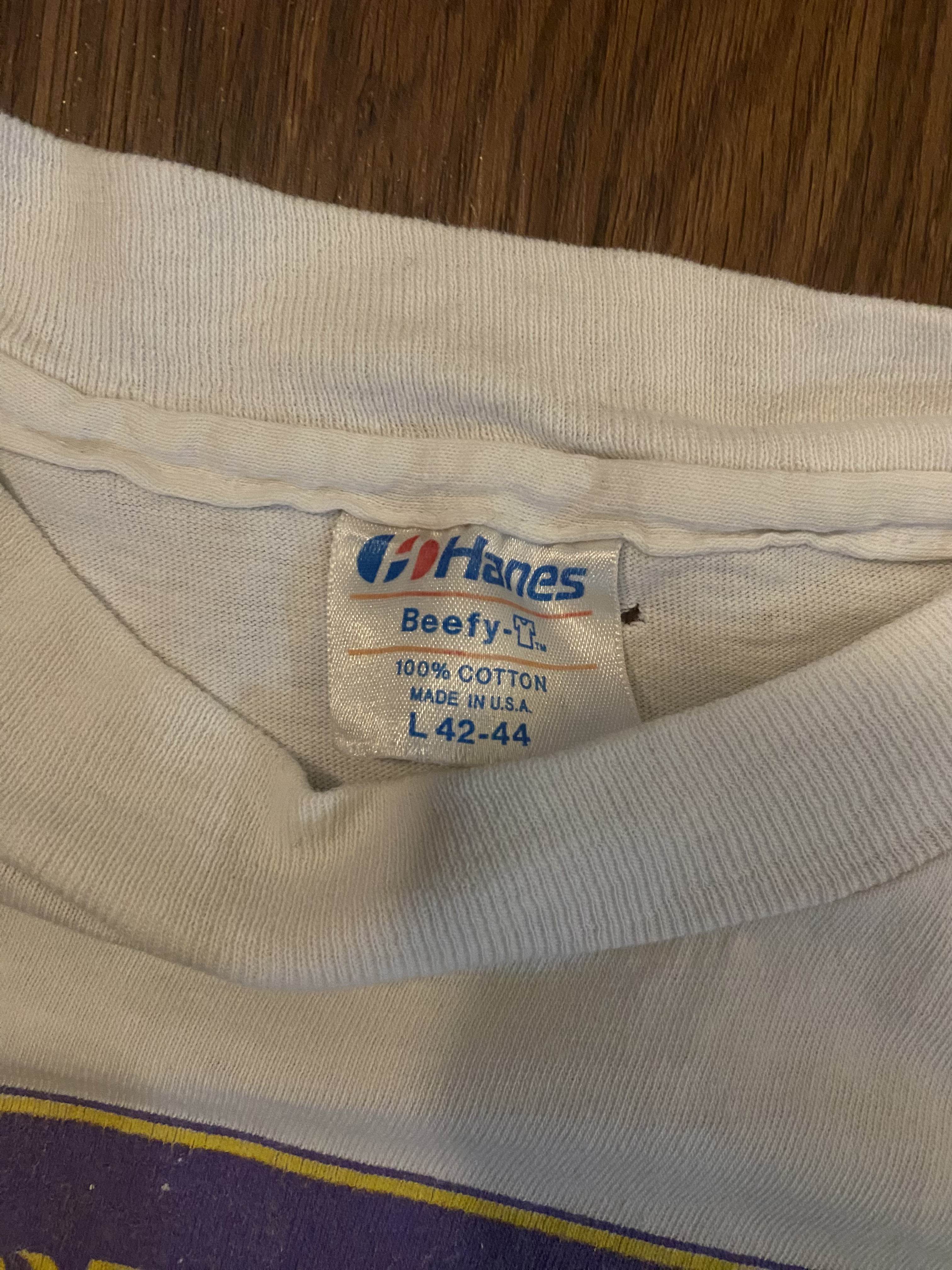
The chest-measurement tag is one of the most immediately recognizable dating markers in the vintage t-shirt world. Hanes used this sizing convention industry-wide in the late 70s and early 80s before the shift to standardized letter sizing — S, M, L, XL — that collectors now take for granted. Finding "Adult XL (46-48)" on a Beefy-T tag is the equivalent of a date stamp: you're holding something from the first half of the Reagan administration or earlier.
The two archive examples span the very opening of the Dead's commercial merchandise era (NYE 1981-82, Oakland Auditorium) and the early souvenir printing market (Oregon Rose City, early 80s). Both are on identical blanks — same tag, same construction — which confirms the Beefy-T was already the printer's blank of choice by 1981, a position it would hold for the next fifteen years.
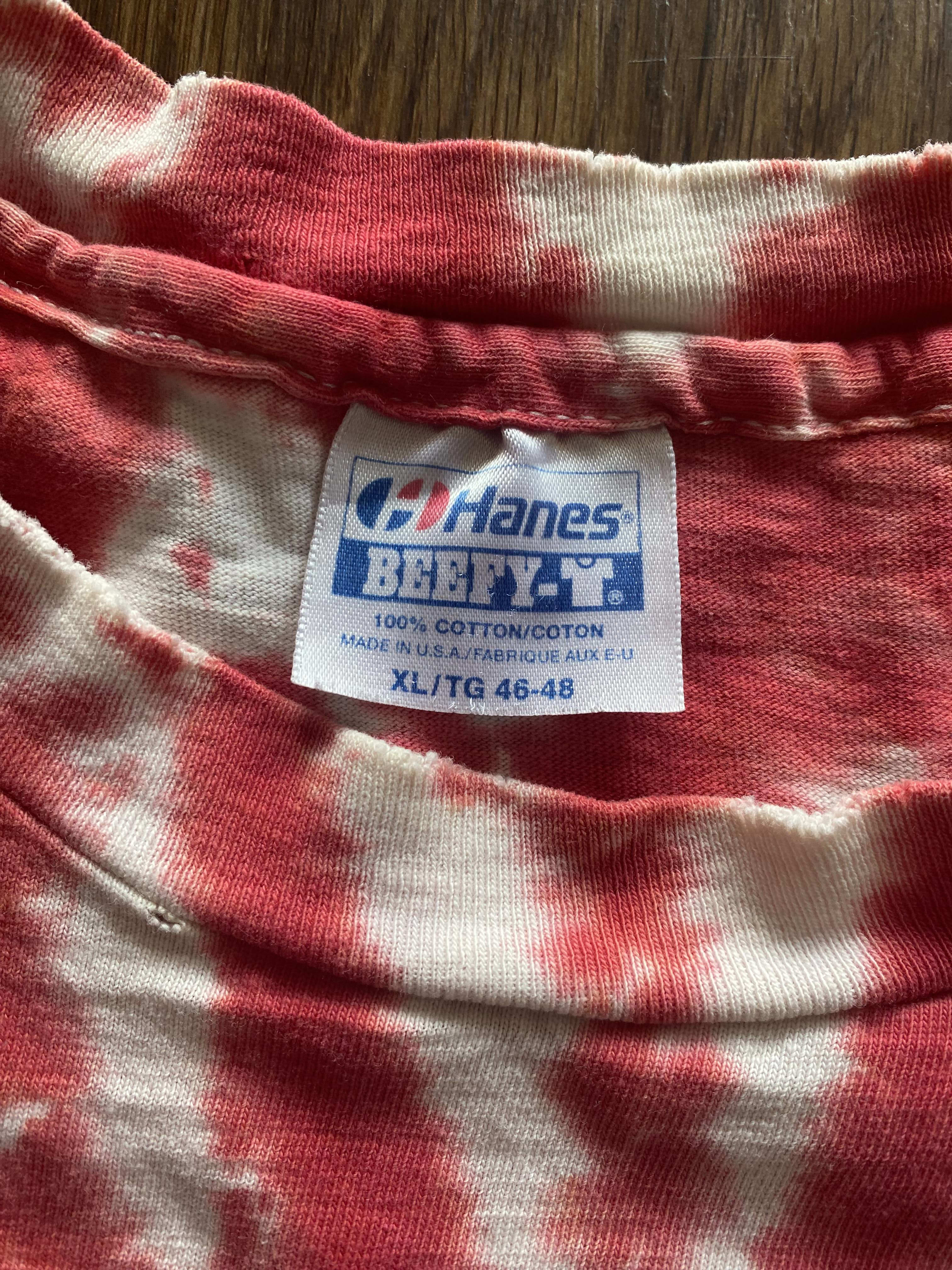
The early 90s domestic Beefy-T is the sweet spot for collectors — it has the feel and weight of the classic blank, the construction quality of domestic manufacturing, and the print surface that made it the preferred substrate for the screen printing industry's peak decade. This is the blank under a significant portion of the collegiate, souvenir, and concert merchandise that defines early 90s vintage.
The Indiana University tie-dye in the archive (TT-000023) is a clean example — spiral dye over a domestic blank, IU interlocking monogram on front, the Beefy-T tag confirming the origin. Collegiate licensing merchandise of this era leaned heavily on Hanes for the blank. The university bookstore and licensed printers knew the blank, trusted the consistency, and the Beefy-T absorbed dye and ink in a way that cheaper alternatives couldn't match.
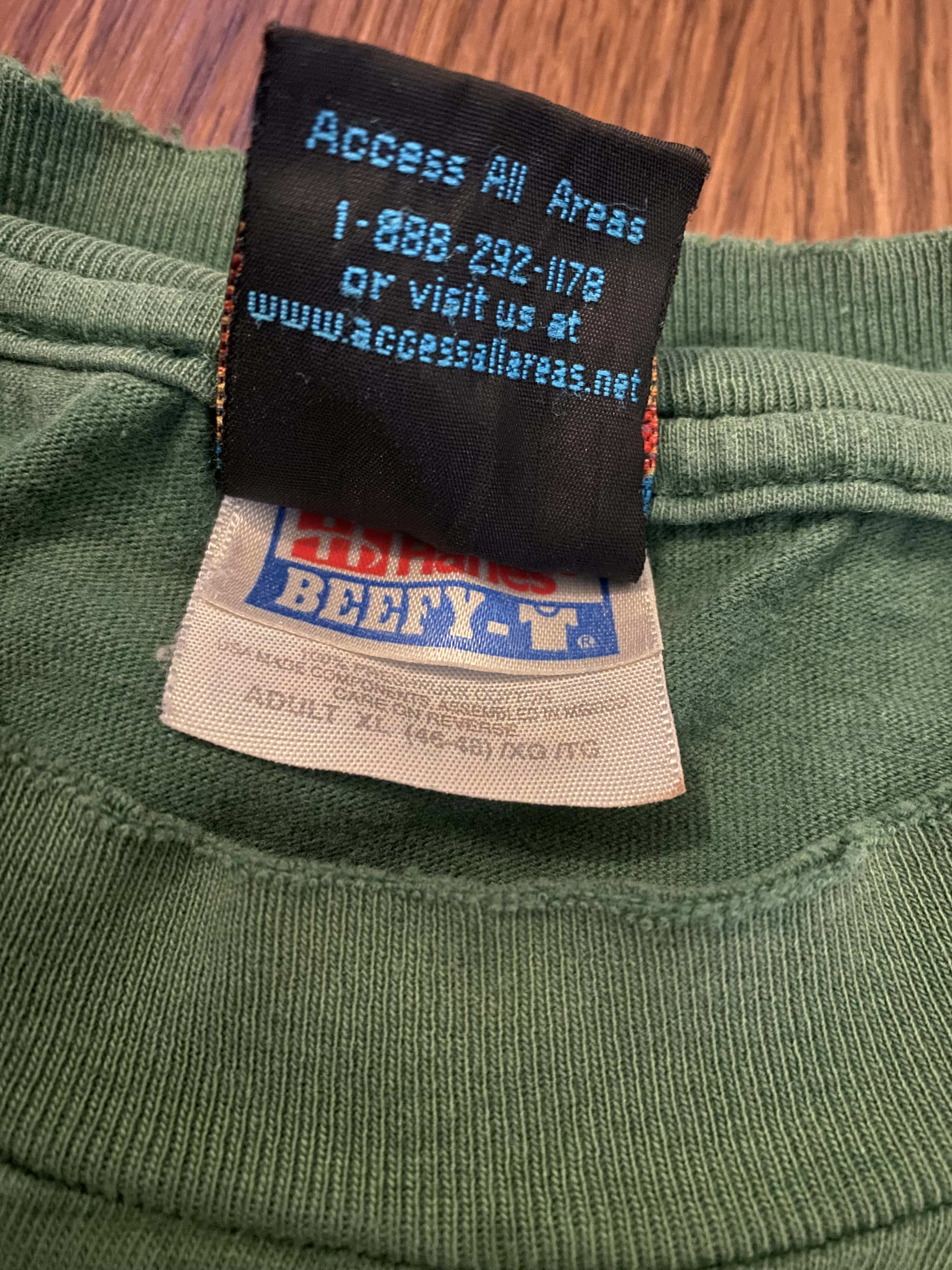
The Honduras Beefy-T is a different object from its domestic predecessor, and not just because of where it was made. The double-stitch construction changes the hand of the seams. The fabric weight is consistent — Hanes maintained the Beefy-T's spec — but the feel of the finished garment is subtly different to anyone who handles a lot of vintage. Not lesser, exactly. But different.
The archive example (TT-000036) is the Grateful Dead's Summer 1989 "Access All Areas" reissue — a licensed GDP Inc. piece from the post-Jerry catalog era, forest green tie-dye ground with a Steal Your Face tree spirit graphic. The fact that GDP was putting official licensed merch on Honduras Beefy-T by the late 90s is itself a data point: the blank's reputation survived the offshore transition intact. Printers and licensees kept reaching for it even after "Made in USA" left the tag.
Hanes was founded in 1901 in Winston-Salem, North Carolina, as a hosiery company. By the mid-twentieth century it had expanded into underwear and t-shirts, and by the 1970s it was the largest apparel manufacturer in the United States. The Beefy-T, introduced in 1975, was a specific product decision — a heavier-weight t-shirt aimed at the promotional and screen printing market, which wanted something more substantial than the lightweight blanks that dominated the mass market.
The name was not subtle. Beefy-T meant weight. The 6.1 oz cotton was heavier than anything competitors were offering at scale. Screen printers discovered that heavier fabric held ink differently — less bleed, better opacity on dark garments, a more substantial hand after washing. The blank became a default for anyone who wanted a shirt that felt like it was worth something.
Through the 1980s and into the early 90s, the Beefy-T was manufactured domestically in Hanes's Carolina operations. The Caribbean Basin Initiative and subsequent trade policy shifts created the same pressure on Hanes that it created on every American apparel manufacturer — offshore production was simply cheaper. By the late 90s, Honduras had become Hanes's primary production country for the Beefy-T. The blank survived the transition. The domestic manufacturing did not.
What the tag tells you, in this case, is a story about American industrial geography: the arc from Winston-Salem to Tegucigalpa, measured in decades and stitches.